Increments

Time is limited, and since I am usually moving several projects forward at any given moment, I tend to use what Oliver Burkeman refers to, in his excellent book “Four Thousand Weeks,” as radical incrementalism. For me, this means writing in small increments of time, usually an hour or two. Sometimes it’s just a few minutes spent capturing ideas in IOS Notes during a liminal part of the day. As a creative process, this actually works well because breaks are essential to my clarity of mind, particularly during revisions, which make up the bulk of the work. Typically, when revising my work I go back over the previous sessions of work before starting a new section. This is an effective way of capturing errors—choppy flow or snags in readability. In this manner, it’s possible to produce book length works without bailing on everyday life.

Other than Notes, one of my favourite apps, I work in Scrivener (v3.4). Scrivener allows me to pull a project apart, so the pieces are laid out like a plastic model kit. I am not one of those magical writers that can hold it all in my head so I need a trusted repository. For this reason Scrivener is well suited to the incremental approach. It’s much easier to face a single chapter, with a synopsis and notes on the same screen, than a Word document with its crushing column of 100K words. I have tried many other writing apps, but I keep returning to Scrivener.


We lost David Lynch this week. His death could not have come at a worse time. But it was the times that took him. I read this morning that he died from complications resulting from being moved due to the LA fires. Poignant news given that fire was such a critical aspect of his vision.

I never met David Lynch, though it was not for lack of trying: Thank you for sending this very thoughtful request. Unfortunately, Mr. Lynch would like to politely decline participation in this project. However, he wishes you the best of luck, and thanks you for thinking of him. Thanks for understanding. I would wager he never saw my proposal, but it’s fun to day-dream about the what if. Lynch’s daydreams gave me, and so many others, touchstones on the journey of creative expression. His aesthetic spoke to me from the first. I grew up in a heavily industrialized area and the sounds and visuals of Eraserhead felt immediately familiar. The Elephant Man was profound, and even Dune, which he later distanced himself from, had a powerful effect on my developing artistic sensibilities. I can think of no other artist, except maybe the Brothers Quay, that so excited and gave me hope. Lynch’s view on creativity was, and remains, refreshing and liberating.

  • Richard

Thru the darkness
of Future Past
the magician longs to see
once chants out
between two worlds
Fire—walk with me.
David Lynch

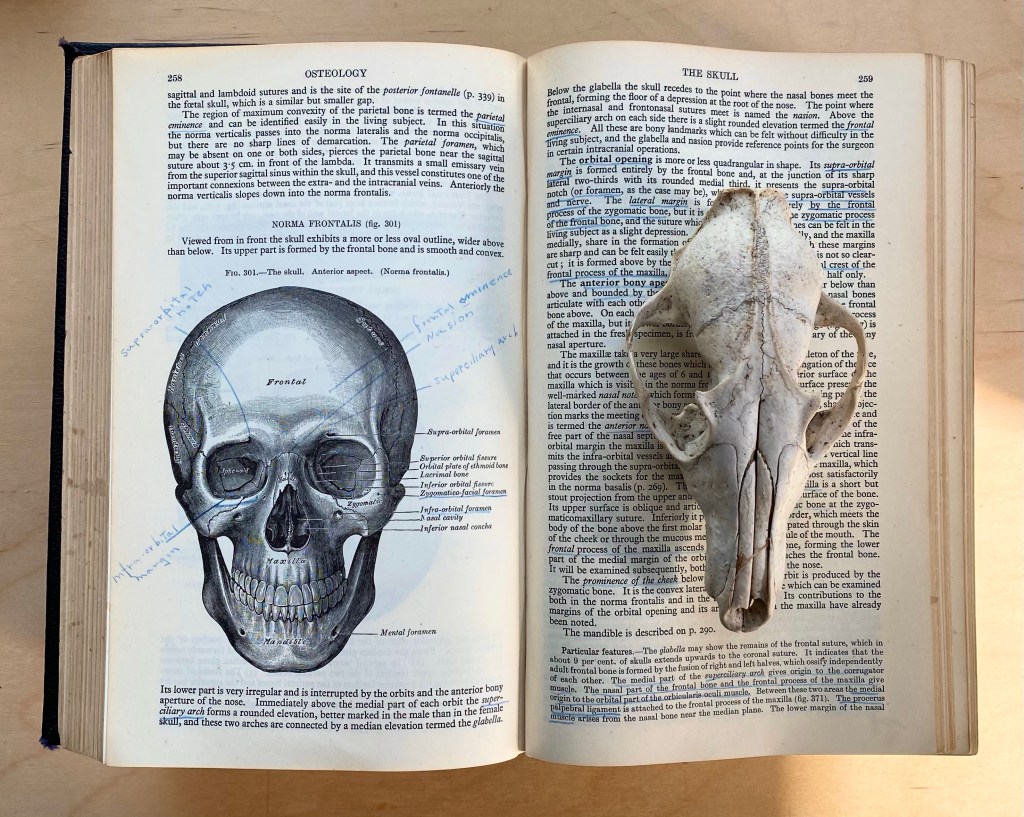
Anterior Aspect

Grey’s Anatomy, Descriptive and Applied, 29th edition, 1946, with marginalia

Unfortunately he was struck down by an attack of confluent smallpox, which he contracted while looking after a nephew who was suffering from that disease, and died at the early age of thirty-four.

From a brief biography of Henry Grey

Is any artist’s library complete without a copy of Grey’s? I’ve plundered mine countless times for inspiration and reference and always enjoyed coming across the traces of past owners, their notes and highlights. Until today however, I never noticed this line about Grey’s death. It was all the more powerful given the pandemic we are currently living through, and particularly poignant that he lost his life while helping someone else.

My photo for today was inspired by the work of Rosamond Purcell.

Inklings

The last drops of the thundershower had hardly ceased falling when the Pedestrian stuffed his map into his pocket, settled his pack more comfortably on his tired shoulders, and stepped out from the shelter of a large chestnut tree into the middle of the road.

Out of the Silent Planet, C.S. Lewis

On a certain day in June, 19—, a young man was making his way on foot northward from the great City to a town or place called Edgewood, that he had been told of but never visited. His name was Smoky Barnable, and he was going to Edgewood to get married; the fact that he walked and didn’t ride was one of the conditions placed on his coming there at all.

Little, Big, John Crowley

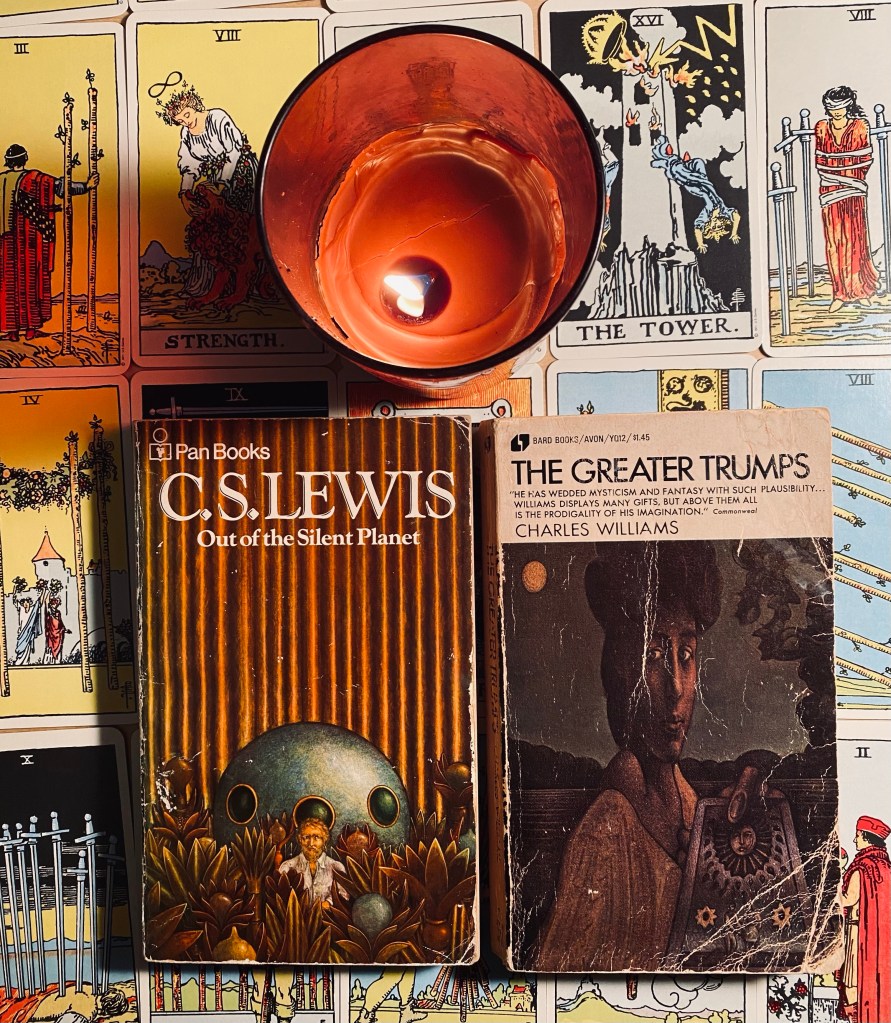
I began this post to comment on my love of the Bard Books/ Avon imprint. These books, once ubiquitous, are now are seen most frequently in used book shops. Charles Williams made me think of C. S. Lewis, of course, and the opening paragraph of Out of the Silent Planet made me think of the opening of Little, Big, and this is how works of literature speak together through us. It’s also why I will never thin out my library. There is no greater joy than following a trail of breadcrumbs through your collection of books.

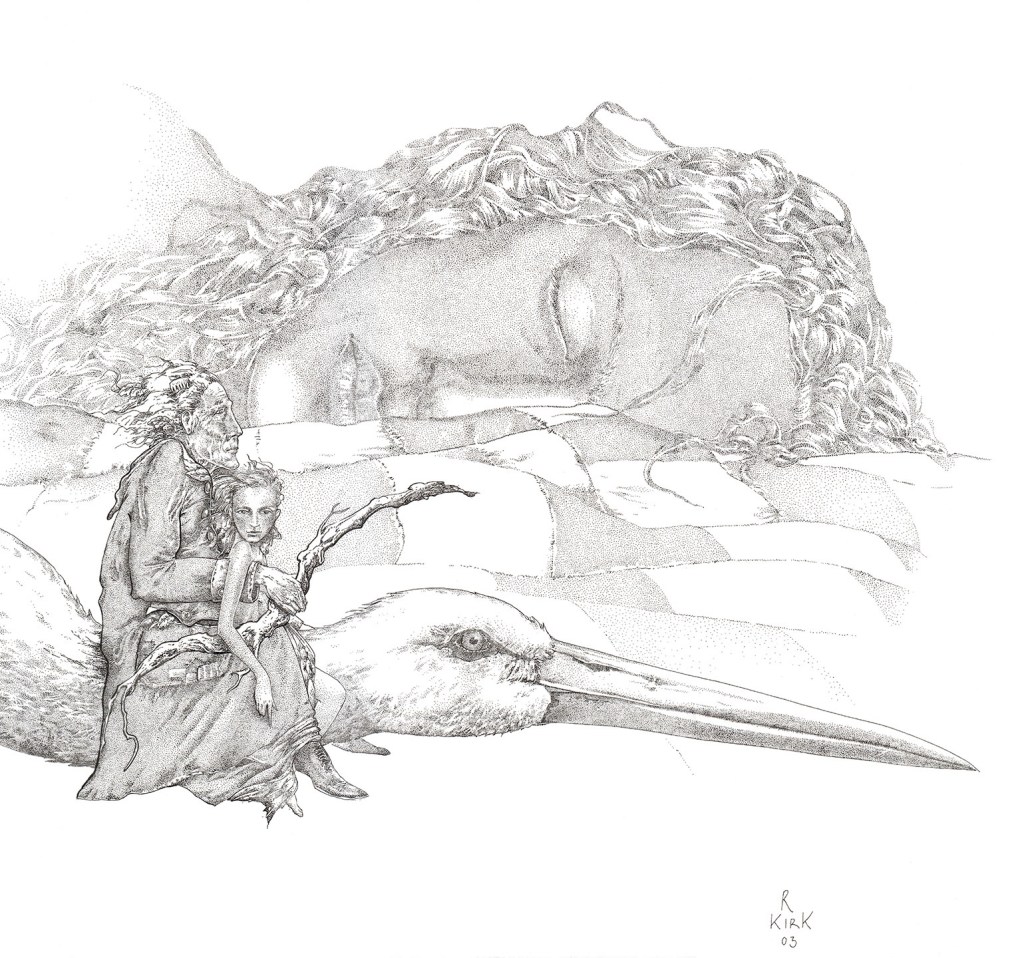
For fun, here is a piece of art I did back in 2003, inspired by John Crowley’s Little, Big.

Lilac from Little, Big, by John Crowley

Reading List

So many books are inextricably connected with friendships. I still remember the moment in the 1970s when a friend insisted I read Out of the Silent Planet by C. S. Lewis while we were waiting for his Greyhound in a snowstorm. He nearly missed his bus when we made a mad dash for a nearby bookstore. On another occasion I was leaving a friend’s house in Toronto when she handed me a copy of John Crowley’s Little, Big, a book that remains a favorite to this day. A few years ago, my friend Tim passed away. Our friendship was based on words – we never met in the real world, just online. Tim, a writer and instructor of writing during his life, was well read and often recommended authors to me. Here are few, which include some old friends and some yet to meet.

Paul West

Frank Kafka

Adolpho Biyo Carares

Elias Canetti

Borges

Silvina Ocampo

Julio Cortazar

Robert Walser

Thomas Ligotti

Walter Benjamin

Robert W. Chambers

Poe

Umberto Echo

Gerard de Nerval

Vladimir Nabokov

Hugh Walpole: The Best Supernatural

William Sansom

Hoffmann

Samuel Beckett

Thomas Bernhard

Blanchot

Stanislaw Lem

Jean Paulhan

Used Books

One of the great joys of venturing out as things gradually reopened from the Covid-19 lockdown was the discovery that the nearby used bookstore hadn’t packed it in. I drove there fully expecting to find the windows dark and some kind of sad goodbye in Sharpie block letters taped to the window. Not at all. Sure, there was a sheet of Plex hanging over the cluttered desk, and there was a limit to how many people could be in the store at any given time (surely a gesture of great optimism), but it was open for business, and within 60 seconds I’d found a trade sized copy of Jonathan Strange and Mr. Norrell by Susanna Clarke (lots of luck finding that in a big box book store. All they have is the horribly inadequate mass market edition – trust me, I looked) and this beautiful book of Eugene Atget’s photographs.

I’ve known about Atget for years. I used one of his photographs as a reference for my drawing called Coincidental Misfortune. But this was a happy reunion. The photos of old Paris are sure to inspire my current writing, which is a second world novel that takes place in a crumbling old city – of course it does. The crumbling textures and mysterious windows will surely find their way into my drawings.

In another life, I would have loved to own a second hand bookstore. Maybe once and a while I would even have opened the door to share the treasure.

Vesper Flights

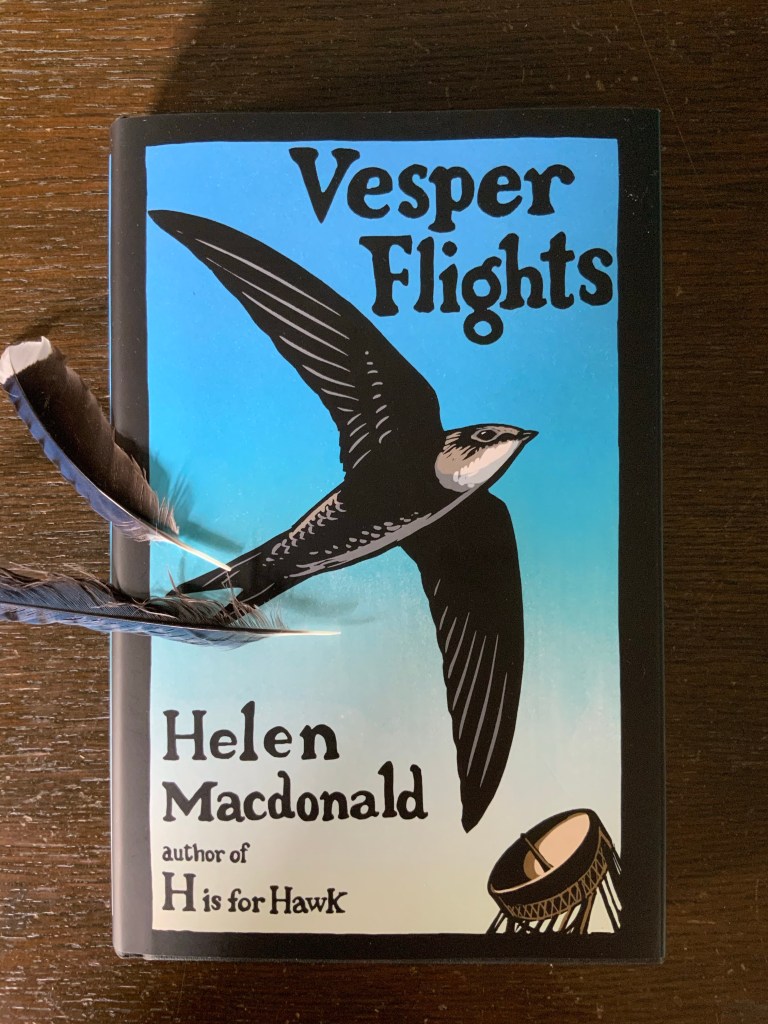
I am enjoying Vesper Flights by Helen Macdonald. It seems the perfect book for this moment. These essays vary in length and it’s the longer pieces I like best. My favorites so far are Tekels Park and In Her Orbit. Tekels Park reminded me of my own childhood explorations and In Her Orbit, introduced me to Nathalie Cabrol and her fascinating research.

Macdonald’s observations are always interesting and filled with unexpected pieces of information. Did I mention she writes beautifully? The thing I like best about this book is that despite the frequent acknowledgement about the sorry state of our natural world, there is an underlying curiosity and sense that there is still so much to see and learn about. I haven’t read H is for Hawk, but I will soon.