Increments

Time is limited, and since I am usually moving several projects forward at any given moment, I tend to use what Oliver Burkeman refers to, in his excellent book “Four Thousand Weeks,” as radical incrementalism. For me, this means writing in small increments of time, usually an hour or two. Sometimes it’s just a few minutes spent capturing ideas in IOS Notes during a liminal part of the day. As a creative process, this actually works well because breaks are essential to my clarity of mind, particularly during revisions, which make up the bulk of the work. Typically, when revising my work I go back over the previous sessions of work before starting a new section. This is an effective way of capturing errors—choppy flow or snags in readability. In this manner, it’s possible to produce book length works without bailing on everyday life.

Other than Notes, one of my favourite apps, I work in Scrivener (v3.4). Scrivener allows me to pull a project apart, so the pieces are laid out like a plastic model kit. I am not one of those magical writers that can hold it all in my head so I need a trusted repository. For this reason Scrivener is well suited to the incremental approach. It’s much easier to face a single chapter, with a synopsis and notes on the same screen, than a Word document with its crushing column of 100K words. I have tried many other writing apps, but I keep returning to Scrivener.


We lost David Lynch this week. His death could not have come at a worse time. But it was the times that took him. I read this morning that he died from complications resulting from being moved due to the LA fires. Poignant news given that fire was such a critical aspect of his vision.

I never met David Lynch, though it was not for lack of trying: Thank you for sending this very thoughtful request. Unfortunately, Mr. Lynch would like to politely decline participation in this project. However, he wishes you the best of luck, and thanks you for thinking of him. Thanks for understanding. I would wager he never saw my proposal, but it’s fun to day-dream about the what if. Lynch’s daydreams gave me, and so many others, touchstones on the journey of creative expression. His aesthetic spoke to me from the first. I grew up in a heavily industrialized area and the sounds and visuals of Eraserhead felt immediately familiar. The Elephant Man was profound, and even Dune, which he later distanced himself from, had a powerful effect on my developing artistic sensibilities. I can think of no other artist, except maybe the Brothers Quay, that so excited and gave me hope. Lynch’s view on creativity was, and remains, refreshing and liberating.

  • Richard

Thru the darkness
of Future Past
the magician longs to see
once chants out
between two worlds
Fire—walk with me.

David Lynch

Radiolaria Studios

I’ve jumped into 2025 with an overdue reorganization of my on-line world. Recently, I deleted my Substack—the format just wasn’t for me. I’ve long enjoyed WordPress and over time it has developed functionality that meets my needs as a creative. So my focus will now be on my WP art blog, and this blog, which is dedicated to words.

I’ve have now changed the name of this, my long dormant book blog, from Amnesiac’s Library to Radiolaria Studios. The original idea behind the blog was to highlight and share things I happened to be reading. Radiolaria Studios is a name I’ve used over time to publish a novella, The Lost Machine, and various prints. Although it too has been dormant for a while, I am bringing it back this year to publish some smaller writing projects—think illustrated novellas and chapbooks. While I continue to aspire to publish in the commercial book world, I also believe I need to make room for quieter projects close to my heart. For that reason, Amnesiac’s Library becomes Radiolaria Studios. Going forward, this blog will focus on the literary end of my creative output. It will be a blog to chat about books I am excited about and my own projects. Richard A. Kirk Art will remain focused on my visual art.

For long haulers, thank you for supporting my work on all fronts. For people new to my work, welcome!

  • Richard

The Recognitions

I started the Recognitions a couple of weeks ago. Not rushing this one. I read a few pages every morning with my coffee. It’s dense and often funny. By the time I reach the end of this book, I am sure I will have read it 4 times. My brain seems most receptive to it in the hours before the concerns of the day start flooding in. The first couple of chapters concern the artist Wyatt as a young boy growing up motherless in a religious household and his relationships with his father and an elderly Aunt. There is a fascinating and disturbing episode with a barbary ape brought home by the Reverend Gwyon from his overseas travels. Later, when Wyatt is an adult, attempting to make his way as a painter, there is a pointed interaction with a critic that has a cruel impact on his aspirations. Following this, are a series of conversations with Wyatt’s wife Esther, who is confounded by Wyatt’s “work,” that make for compelling reading. I’ll post more of my impressions as I continue with The Recognitions.

While even Aunt May’s medieval posture could not credit her stomach as a cauldron where food was cooked by heat from the adjacent liver, she sought evidences of the Lord’s displeasure in foreign catastrophes and other people’s difficulties, and usually found good reason for it.

p.33

What’s any artist, but the dregs of his work, the human shambles that follows it around.

p. 95

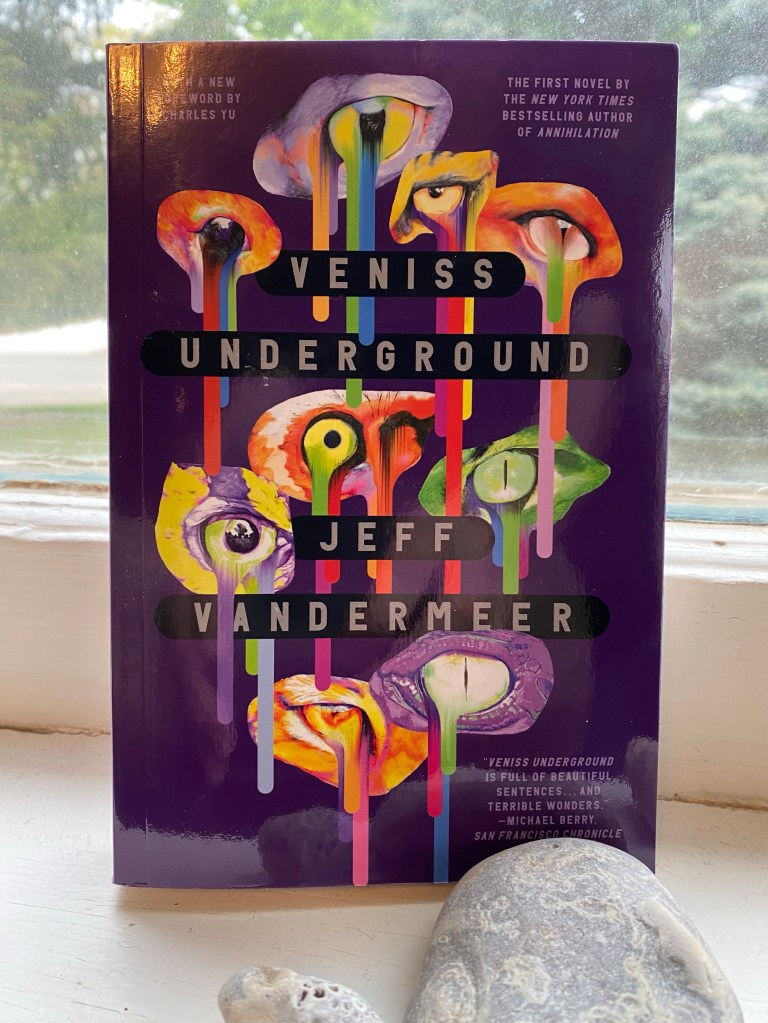
Veniss Underground

Veniss Underground by Jeff VanderMeer, McClelland & Stewart, 2023. Cover art and design by Tyler Comrie.

I took advantage of the recent reissue of Jeff VanderMeer’s Veniss Underground (originally published in 2003) to fill in a lamentable gap in my reading. What worked best for me in this novel were the creatures VanderMeer conjures—segmented worms turning into flying maps, ray-like creatures in a subterranean sea and the unforgettable Gollux.

In the afterword, there’s a writing fragment, which illuminates the novel, and a great background story about York Minster providing the inspiration for the writing process. These insights were unexpected and fascinating.

I recommended this book if you like phantasmagorical imagery and dark humour.

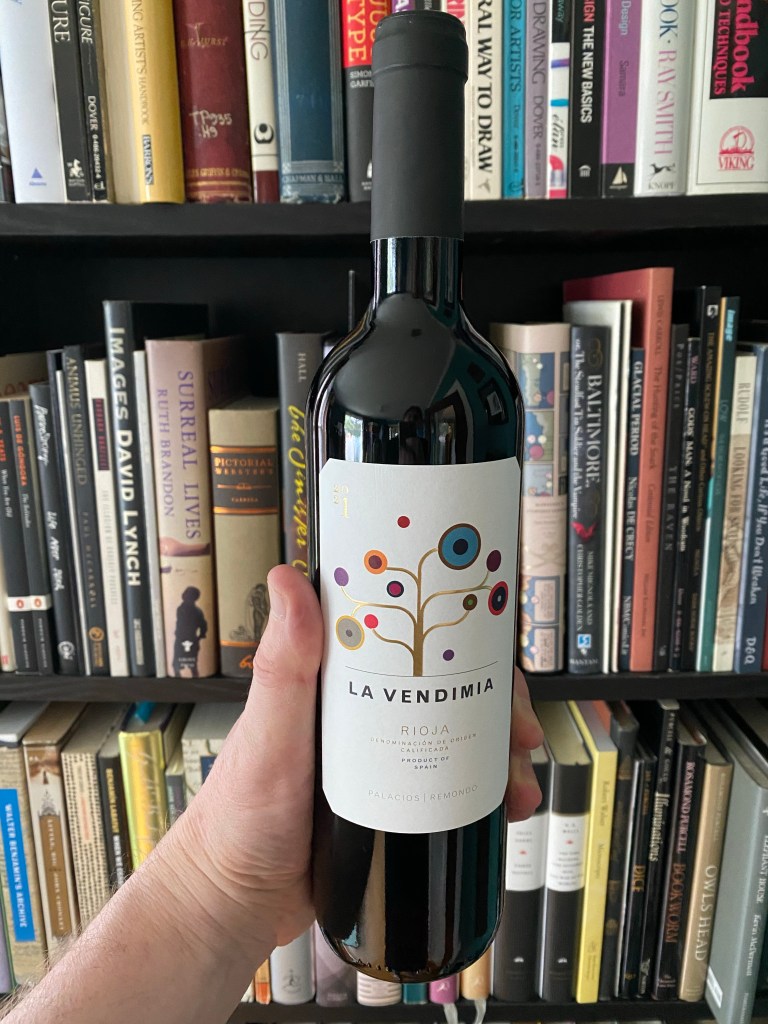
A Nice Pairing

This is a book blog, not a wine blog, but if you are able to enjoy a glass, this one pairs well with a good browse of the shelves. La Vendimia, Rioja is from Spain. The colour is a beautiful ruby red, especially against the mellow May evening light. It has slightly more alcohol than the Italian wines I’ve tried lately. The flavour has a slightly bitter aftertaste that I quite enjoyed. Definitely a bolder taste. I love the label design on this wine as well, which is clean, playful and made me think of Miro.

A Return to Form

I’ve let an unconscionable amount of time slip by since I last posted to Amnesiac’s Library so I’d like to re-introduce myself. My name is Richard Kirk. Friends know me as Rick. My twin passions are art and books. I have a WordPress blog where interested parties can keep up with the art end of things, but I created Amnesiac’s Library some time ago to document my love of books, real paper books (full disclosure, I do have a Kindle, 3 in fact, but it’s just not the same is it?) Amnesiac’s Library is a dedicated place to highlight what I am reading, cool used book shop finds, book related things that catch my eye and from time to time, my own writing. If you love books as much as I do, please consider subscribing to Amnesiac’s Library!

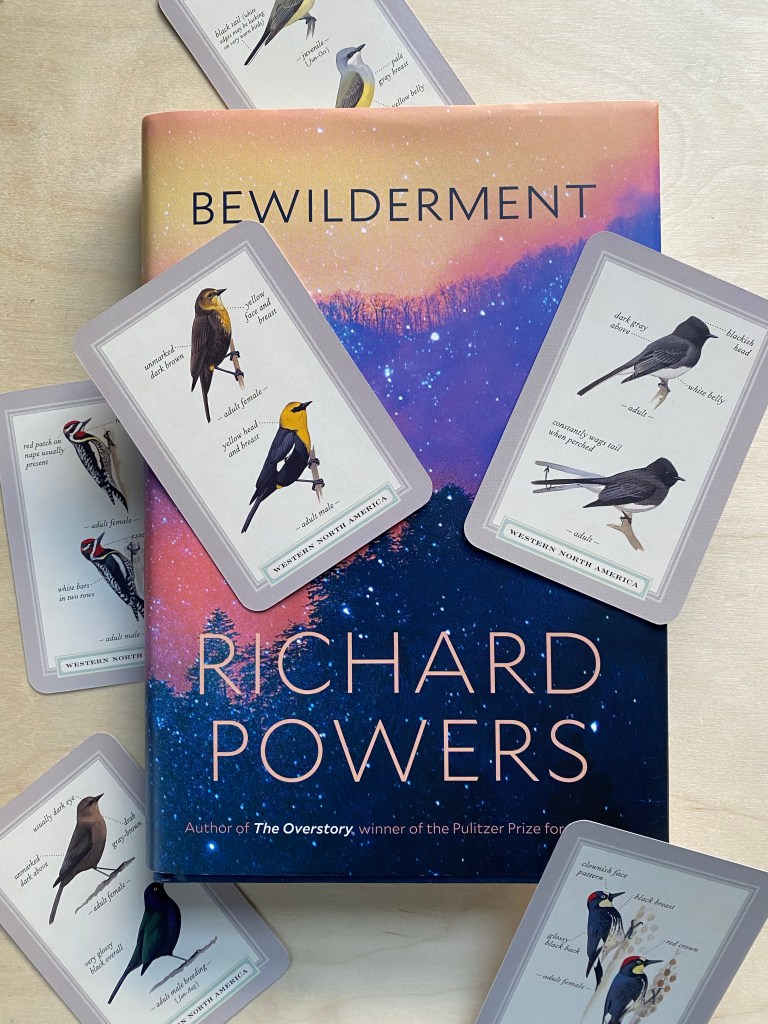
Bewilderment

Bewilderment by Richard Powers. Cards from Sibley Backyard Birding Flashcards David Sibley

I finished Bewilderment at the end of October. There is much to like here, the retelling of Flowers for Algernon, the invented planets shared by the father and son at bedtime, the barely concealed references to real public personalities, all worked into a compelling and moving narrative. What I enjoyed most about this book though was the character of the mother, powerfully present in her absence. Her personality sometimes felt like one of the imaginary planets described by the narrator, pieced together from memories and the perceptions of others, particularly her son, the way one might ascertain the composition of a distant celestial object through the scattering of light.

I started reading Powers back in the early 1990s with The Gold Bug Variations on a transatlantic flight to England. Since then, I’ve read him periodically and long the way I bought most of his novels faithfully on publication. Reading Bewilderment made me want to go back and fill the gaps.

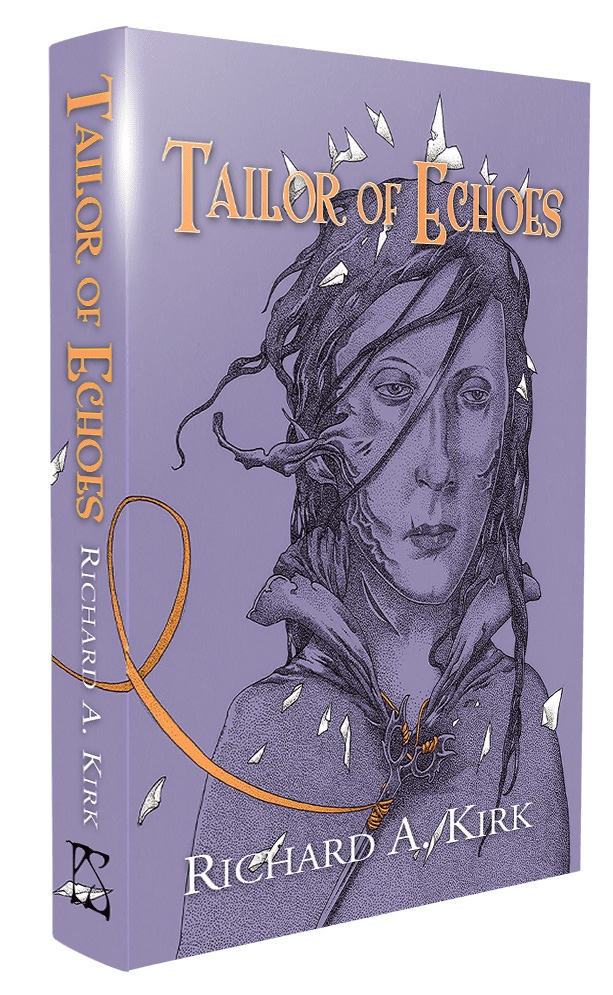
Tailor of Echoes Cover Reveal

I’ve been away from Amnesiac’s Library for quite some time now. It was a very busy summer and fall, but now that the weather is cooling down it is the perfect time to jump back in and tell you about the books I’ve been enjoying.

But first, I want to show you the cover of my new novel Tailor of Echoes. The book will be published by PS Publications in December 2021. In addition to the cover art, I also created 10 illustrations for the interior. The book is now available for preorder on the PS Publication’s site.

Tailor of Echoes is available in a hardcover edition and a signed and numbered edition of 100!

The ancient City of Steps is transforming. Alleys and staircases appear where none previously existed. A tree is discovered at the bottom of a canal. In his search for the cause, a young, visionary architect, Adrian Peak, falls afoul of a secret society known as the Curators. The Curators task Adrian with finding a lost document called the Oneiric Chart in their vast sealed library. The chart is the key that opens a door to a shadow city in another, eerily familiar world. Lannikin Flower, the Curator’s shadowy servant, has deeply personal interest in Adrian’s failure.

Here is a little peek at one of the interior illustrations in for Tailor of Echoes when it was in progress this summer.