Increments

Time is limited, and since I am usually moving several projects forward at any given moment, I tend to use what Oliver Burkeman refers to, in his excellent book “Four Thousand Weeks,” as radical incrementalism. For me, this means writing in small increments of time, usually an hour or two. Sometimes it’s just a few minutes spent capturing ideas in IOS Notes during a liminal part of the day. As a creative process, this actually works well because breaks are essential to my clarity of mind, particularly during revisions, which make up the bulk of the work. Typically, when revising my work I go back over the previous sessions of work before starting a new section. This is an effective way of capturing errors—choppy flow or snags in readability. In this manner, it’s possible to produce book length works without bailing on everyday life.

Other than Notes, one of my favourite apps, I work in Scrivener (v3.4). Scrivener allows me to pull a project apart, so the pieces are laid out like a plastic model kit. I am not one of those magical writers that can hold it all in my head so I need a trusted repository. For this reason Scrivener is well suited to the incremental approach. It’s much easier to face a single chapter, with a synopsis and notes on the same screen, than a Word document with its crushing column of 100K words. I have tried many other writing apps, but I keep returning to Scrivener.


We lost David Lynch this week. His death could not have come at a worse time. But it was the times that took him. I read this morning that he died from complications resulting from being moved due to the LA fires. Poignant news given that fire was such a critical aspect of his vision.

I never met David Lynch, though it was not for lack of trying: Thank you for sending this very thoughtful request. Unfortunately, Mr. Lynch would like to politely decline participation in this project. However, he wishes you the best of luck, and thanks you for thinking of him. Thanks for understanding. I would wager he never saw my proposal, but it’s fun to day-dream about the what if. Lynch’s daydreams gave me, and so many others, touchstones on the journey of creative expression. His aesthetic spoke to me from the first. I grew up in a heavily industrialized area and the sounds and visuals of Eraserhead felt immediately familiar. The Elephant Man was profound, and even Dune, which he later distanced himself from, had a powerful effect on my developing artistic sensibilities. I can think of no other artist, except maybe the Brothers Quay, that so excited and gave me hope. Lynch’s view on creativity was, and remains, refreshing and liberating.

  • Richard

Thru the darkness
of Future Past
the magician longs to see
once chants out
between two worlds
Fire—walk with me.
David Lynch

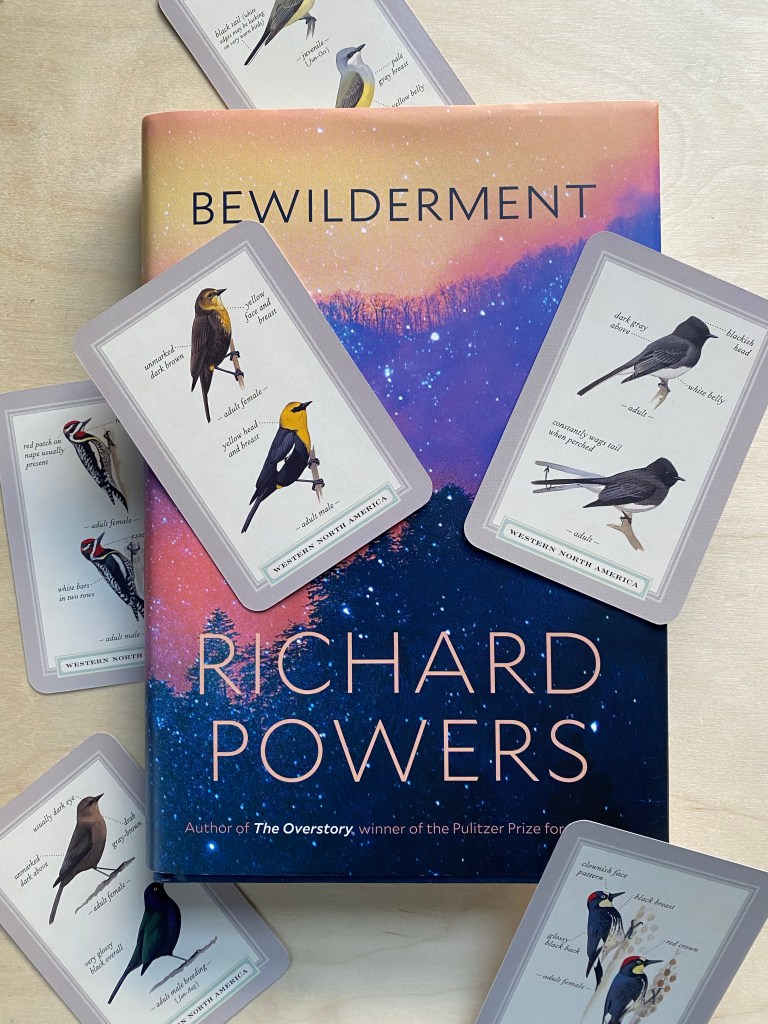
Bewilderment

Bewilderment by Richard Powers. Cards from Sibley Backyard Birding Flashcards David Sibley

I finished Bewilderment at the end of October. There is much to like here, the retelling of Flowers for Algernon, the invented planets shared by the father and son at bedtime, the barely concealed references to real public personalities, all worked into a compelling and moving narrative. What I enjoyed most about this book though was the character of the mother, powerfully present in her absence. Her personality sometimes felt like one of the imaginary planets described by the narrator, pieced together from memories and the perceptions of others, particularly her son, the way one might ascertain the composition of a distant celestial object through the scattering of light.

I started reading Powers back in the early 1990s with The Gold Bug Variations on a transatlantic flight to England. Since then, I’ve read him periodically and long the way I bought most of his novels faithfully on publication. Reading Bewilderment made me want to go back and fill the gaps.

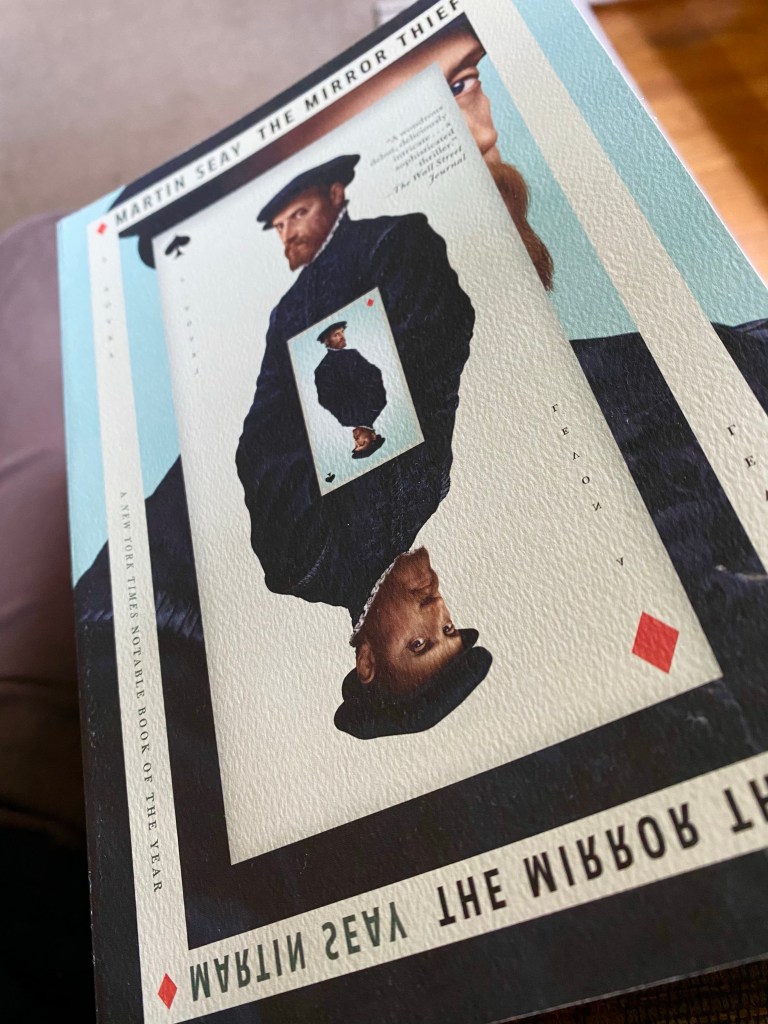
The Mirror Thief

The Mirror Thief, Martin Seay, 2016 Melville House Publishing, ISBN 978-1-61219-559-9. Design by Marina Drukman

I bought Martin Seay’s The Mirror Thief several years ago because it ticked several boxes for me: great title, historical periods, rich descriptive writing, heft. It was the cover by Marina Drukman that caught me first though with its smart design and promise of mystery.

All of that notwithstanding, I didn’t start reading it until this summer. I am about halfway through. So far, there have been sections taking place in Las Vegas in 2003 (unexpected), Venice Beach California in 1958 and 16th century Venice. Each section expands the book, not only in setting but also in language. I am dying to see how all of this comes together at the end. The book is beautifully researched, but the reader isn’t bogged down by exposition. The second setting especially sent me to the internet to research historic photos of Venice Beach—a rabbit hole that consumed the better part of an evening.

Richard

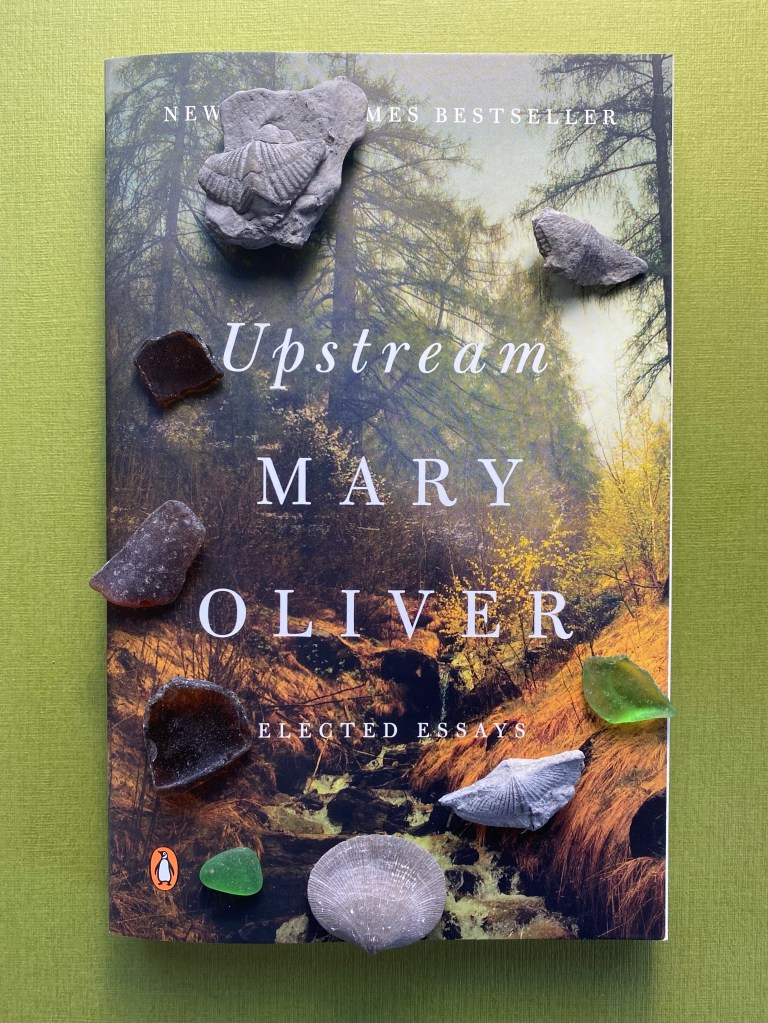
Upstream

Upstream, Mary Oliver, Penguin 2016

Getting back to this book blog after a period of general life business.

I finished Mary Oliver’s collection of essays a few weeks ago. I am new to her writing and wish I’d discovered it earlier. I could have benefitted from the wisdom in these beautiful essays on art, creativity, nature and memory many times during my life. This is one of those books you burden with sticky notes and underlining. Oliver’s unsentimental observations about animals, foxes, birds, spiders and turtles are enthralling and occasionally shocking, but it is her reflections on creativity that really spoke to me.

The clock! The twelve-figured moon skull, that white spider belly.”

Of Power and Time

No one has yet made a list of places where the extraordinary may happen and where it may not. Still, there are indications. Among crowds, in drawing rooms, among easements and comforts and pleasures, it is seldom seen. It likes the out-of-doors. It likes the concentrating mind. It likes solitude. It is more likely to stick to the risk-taker than the ticket-taker. It isn’t that it would disparage comforts, or the set routines of the world, but that its concern is directed to another place. It’s concern is the edge, and the making of a form out of the formlessness that is beyond the edge.

Of Power and Time

The most regretful people on earth are those who felt the call to creative work, who felt their own creative power restive and uprising, and gave to it neither power nor time.

Of Power and Time

Quincunx

But now, when I tried to see the whole affair from the point of view of the self interest of each of the parties involved, the anomaly came to me suddenly.

The Quincunx, Charles Palliser

I spent most of the Christmas break reading The Quincunx, which somehow I’d managed to put off since it was recommended to me sometime in the 1980s. At 781 pages, it it the longest novel I’ve read in a while. It also weighs a ton. I think it left a permanent groove in my chest. It’s dense, immersive and in places harrowing. For this image, I paired it with Philip Davies’ Lost London, 1870-1945, which is filled with beautiful archival images of London. Both books are highly recommended.

Reading List

So many books are inextricably connected with friendships. I still remember the moment in the 1970s when a friend insisted I read Out of the Silent Planet by C. S. Lewis while we were waiting for his Greyhound in a snowstorm. He nearly missed his bus when we made a mad dash for a nearby bookstore. On another occasion I was leaving a friend’s house in Toronto when she handed me a copy of John Crowley’s Little, Big, a book that remains a favorite to this day. A few years ago, my friend Tim passed away. Our friendship was based on words – we never met in the real world, just online. Tim, a writer and instructor of writing during his life, was well read and often recommended authors to me. Here are few, which include some old friends and some yet to meet.

Paul West

Frank Kafka

Adolpho Biyo Carares

Elias Canetti

Borges

Silvina Ocampo

Julio Cortazar

Robert Walser

Thomas Ligotti

Walter Benjamin

Robert W. Chambers

Poe

Umberto Echo

Gerard de Nerval

Vladimir Nabokov

Hugh Walpole: The Best Supernatural

William Sansom

Hoffmann

Samuel Beckett

Thomas Bernhard

Blanchot

Stanislaw Lem

Jean Paulhan